
GaSb/AlAsSb SAM-APDs detects X-rays and gamma-rays
Author: EIS Release Date: Jul 25, 2019
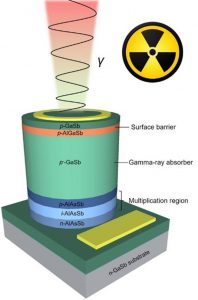
GaSb/AlAsSb ‘separate absorption and multiplication avalanche’ photodiodes (SAM-APDs) can be used to selectively detect high-energy electromagnetic x-ray and gamma-ray radiation, according to the University of California, Los Angeles.
Its research team has built such detectors, that can observe well-defined X-ray and gamma-ray photo-peaks from an americium 241 source (1.55GBq) at up to 59.5keV with a full-width half-maximum of 1.283keV.
In SAM-APDs, the light/radiation absorbing layer is separate from the large bandgap p-n junction which provides amplification, allowing a high avalanche gain with low dark current.
“Our SAM structure is advantageous because it gives much better signal-to-noise ratio due to internal gain,” said UCLA researcher Dr Dingkun Ren. “This is critical to resolve clear high-energy signals. Our detectors are the first SAM-APDs to show clear detection signatures of gamma-rays >50keV.”
Semiconductor material choice was important.
“We use GaSb instead of Si, Ge or GaAs to make absorption regions,” said project lead Dr Bor-Chau Juang. “This is because GaSb can offer much better absorption efficiency and provide a much higher probability to stop those high-energy photons due to its relatively higher atomic number.”
The GaSb absorber is paired with an AlAsSb avalanche junction – the heterostructures were grown using molecular beam epitaxy.
“The GaSb/AlAsSb heterostructure has larger dissimilarity in both pair creation energy and absorption efficiency. This helps to eliminate noise photo-peaks which generate outside the GaSb absorption regions.” said Ren.
The work has been published in Advanced Optical Materials as ‘Energy‐sensitive GaSb/AlAsSb separate absorption and multiplication avalanche photodiodes for x‐ray and gamma‐ray detection‘.
According to its abstract: “Spectroscopic characterisations show a significant improvement of measured energy resolution due to reduced high‐peak electric field in the absorbers and suppressed non-radiative recombination on surfaces. The SAM‐APDs exhibit energy response linearity up to 59.5 keV.”
Actual performance may be better, as it is thought that noise from the read-out electronics is dominating measurements.
The UCLA team is seeking partners with a need to detect and differentiate high-energy radiation, pointing out that other energy-sensitive detectors are used in systems for imaging, medicine and security.