
Isolated 700mA quad smart switches aimed at industry
Author: EIS Release Date: Aug 29, 2019
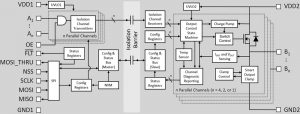
Silicon Labs is aiming at switching industrial loads with a family of quad 24V 700mA isolated 145mΩ switches for resistive or inductive loads – solenoids, relays or lamps, for example, in programmable logic controllers (PLCs).
“The switches are capable of providing up to 0.5A of IEC61131-2 compliant continuous current in a quad channel configuration,” said the firm. “Each switch has many built-in protection features making them extremely robust and flexible load drivers.”
The family is named Si834x and comes in low or high-side switching types, with various input combinations – from four CMOS digital inputs to SPI serial that can control 128 channels with four MCU pins.
Outputs are three-terminal (see diagram), with the switch on the high or low side, and a protection clamp on low or high-side to protect the chip against inductive fly-back over-voltages from the load.
“A multi-voltage smart clamp is used to handle an unlimited amount of demagnetisation energy,” claimed the firm.
Each switch is also protected against over-current and over-temperature, and an extra circuit detects open-circuit loads. Some product versions have an ‘in-rush current mode’ (8A 20ms) to better drive lamps and dc motors. “Additionally, the device power supplies are monitored, and the switches are safely constrained or shut-down if a fault is detected,” said Silicon Labs.
Pending approvals
- UL 1577 up to 1.5kVrms for 1 minute
- CSA certified under IEC 60950-1, 62368-1
- VDE 0884-10
- CQC GB4943.1
- Galvanic isolation
Galvanic isolation is the firm’s CMOS-based technology, that offers >100 kV/µs common-mode transient immunity.
“Si834x isolated smart switch family embodies three generations of Silicon Labs’ isolation innovation for industrial automation,” said Silicon Labs’ general manager Brian Mirkin.
Diagnostic communication is independent of the switch control signals across the isolation barrier, and diagnostics are configured, monitored and cleared through SPI, or through active-low, open-drain indicator pins.
Operation is over -40 to 125˚C, and the devices are in production in 9 x 9mm DFN-32 packages with an exposed centre pad.