
Crystals and oscillators meet tougher automotive and communications requirements
Author: EIS Release Date: Jul 12, 2019
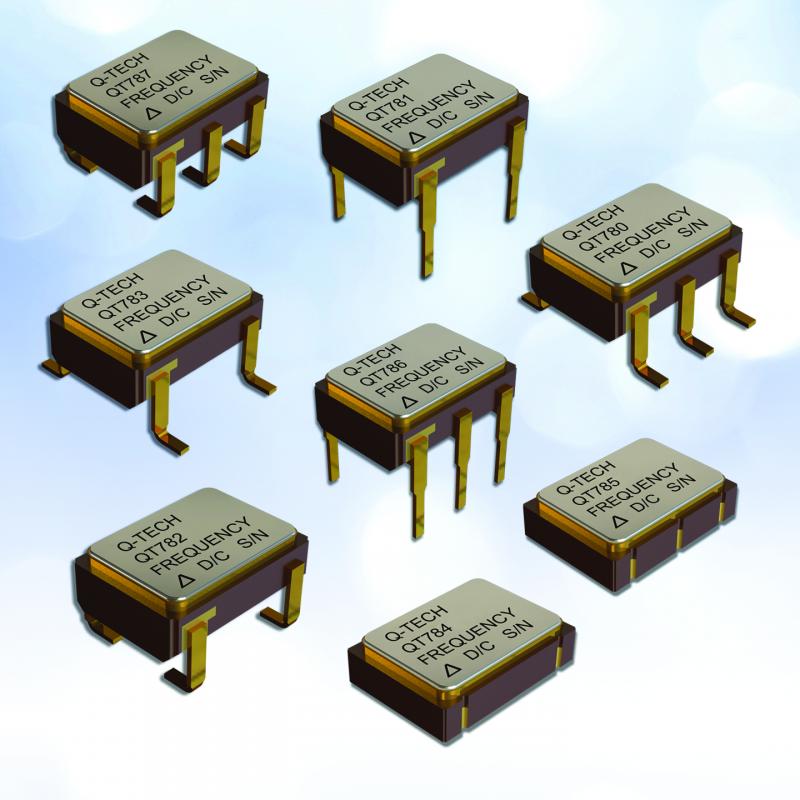
From 5G and ADAS applications to their use in the Deep Space Atomic Clock, crystals and oscillators provide the stability, precision, and frequencies required by a myriad of industry segments
Once digital systems took hold, oscillators moved front and center into microprocessor-based systems to provide clock signals and frequency stability. The use of quartz crystals in oscillators provides that high-frequency stability. Miniaturization and the need for high-performance electronic devices that require tighter frequency tolerance over a wider operating temperature range have driven technology and product improvements. Two of the biggest market drivers have been automotive electronics and wireless communications.
Crystal oscillators, for example, are currently widely used in automotive applications such as brake controls, anti-blocking systems, airbags, and tire-pressure–monitoring systems. They are also increasingly used in advanced driver-assistance systems (ADAS), light detection and ranging (LiDAR), GPS systems, engine control, in-vehicle Ethernet, and autonomous driving applications that need accurate timing solutions and tight frequency stability.
Timing and clocking are critical for high data rate transmission with 4G and 5G networks, creating even greater demand for crystal oscillators. They are also one of the most critical components in systems such as SONET SDH that require a high-stability system clock to prevent time slips or data loss.
Crystal oscillators are used in a variety of applications, including consumer electronics products such as smart wearables, cellphones, video games, and cable TV systems. Other growing applications span space tracking, sensors, measuring instruments, timers, phase-locked loop systems, medical devices, oscilloscopes, and signal generators.
Crystals, oscillators, and crystal oscillators
There are many manufacturers in this marketplace, and it’s important to note that other types of oscillators exist, such as MEMS oscillators that are not crystal-based and are often used in high-vibration environments. Silicon MEMS oscillators are more compact, require less power, and have high efficiency. However, the frequency stability is still behind competitive crystal oscillators.
Kyocera Corp., for example, produces a variety of crystal products, including crystal units and crystal oscillators. The company addresses IoT segments with its products’ unique structures, low current consumption, and decreased lead time. It offers clock oscillators (XOs), voltage-controlled crystal oscillators (VCXOs), and temperature-compensated crystal oscillators (TCXOs) and kilohertz-range crystal devices.
Surface-mount–type crystal units including the CX3225SB, a miniature low-profile crystal, is designed for applications such as digital electronics, mobile communications, consumer products, and car audio and accessories.
In the crystal oscillator area, the KT2520K is a miniature 2.5 × 2 × 0.8-mm TCXO, providing frequency characteristics of ±2.0 × 10⁻⁶/–30°C to 85°C and ±0.5×10⁻⁶/–30°C to 85°C (for GPS). Target applications include GPS units, mobile communications, W-LAN, and low-power radio communications.
Silicon Labs also has a broad portfolio of products. Two of its newest crystal oscillators include the Si56x Ultra Series VCXO and XO and Si54x Ultra Series XO. The Si56x addresses next-gen high-performance timing apps that need ultra-low-jitter oscillators. The VCXO/XO can be customized to any frequency to 3 GHz, which is 2× the operating frequency range of previous Silicon Labs VCXO offerings with half of the jitter. The family features devices with typical phase jitter as low as 90 fs.
In comparison, the Si54x Ultra Series XO family targets applications requiring tighter stability and guaranteed long-term reliability. These include optical transport networking (OTN), broadband equipment, data centers, and industrial systems. Used as a low-jitter reference clock, the Si54x XO maximizes signal-to-noise ratio (SNR) headroom, minimizes bit errors, and enhances signal integrity. It features typical phase jitter as low as 80 fs.
IQD Frequency Products recently launched the IQOV-220 OCXO, featuring high stability and low phase noise. Frequency stability performance is delivered down to ±0.5 parts per billion (ppb) over the full industrial temperature range of –40°C to 85°C, with a short-term stability of 0.5 ppt (tau = 1 s). The IQOV-220 is suited for high-performance synthesizers, network clocks, radar, and satellite communications.