
Top 10 capacitors for automotive applications
Author: EIS Release Date: Jul 12, 2019
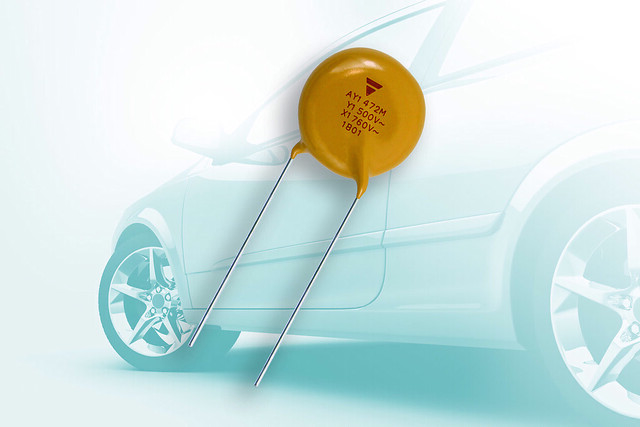
These capacitors reflect the automotive industry’s need for smaller components packed with more performance and the capability to withstand higher temperatures found in most automotive applications
New automotive features and functionality thanks to autonomous vehicle technologies, vehicle-to-vehicle (V2V) communications, advanced driver-assistance systems (ADAS), and other safety and sensing systems like backup cameras and lane-departure detectors are all driving the demand for more electronic components. Also pushing electronic content increases are the industry’s transition to hybrid and electric vehicles.
And the demand is not just for ICs such as processors, memory devices, power semiconductors, and sensors, which have the lion’s share of a design’s cost and mindshare; passive components like capacitors are needed to ensure high stability and interference-free designs.
Here are 10 capacitors in a variety of dielectrics that get the job done. These are not in any particular order:
1. KEMET, T598 tantalum polymer capacitors
Tantalum polymer capacitors like the T598 from KEMET Corp. are finding homes in automotive applications thanks to their low equivalent series resistance (ESR) and now higher temperature range. KEMET extended the temperature capability of its surface-mount tantalum polymer capacitor series, offering stable performance up to 2,000 hours at 125°C, which meets the lifetime requirements of about 15 years for vehicle applications.
The automotive-grade T598 capacitor series is AEC-200–qualified and offers ultra-low, single-digit ESR; high capacitance/voltage (C/V) ratings, increasing the capacitance values up to 470 µF, with voltage offerings from 2.5 VDC to 50 VDC; and leading ripple performance.
Automotive applications include ADAS features such as blind-spot detection, adaptive cruise control, and emergency brake assist, as well as safety systems such as airbag occupant detection, alarm systems, and electronic stability control. These capacitors can also be used in digitalization use cases such as supercomputing, mobility services, connectivity, and infotainment.
2. AVX, F9H tantalum capacitors
Similar to other tantalum capacitors, AVX Corp.’s F9H series of tantalum capacitors plays a double-duty role. These capacitors are suited for harsh and high-reliability environments, targeting high-temperature automotive and industrial applications.
The AEC-Q200–qualified F9H surface-mount, J-lead tantalum capacitors offer high reliability and high volumetric efficiency. Delivering higher reliability than standard automotive-grade capacitors, the F9H parts offer a failure rate of 0.5% after 1,000 hours at 105°C and rated voltage with 0.1-Ω/V series impedance and a 60% confidence level.
The capacitor line is rated for operation up to 150°C and claims the industry’s highest CV/cc in a high-temperature 1206 tantalum capacitor with a 10-μF/16-V rating. This is 50% more capacitance than the next-highest CV/cc 1206 tantalum capacitor at 6.8 μF/16 V.
The F9H series is currently offered with four ratings: 1206 10 μF/16 V, 1206 15 μF/10 V, 1210 22 μF/ 16V, and 2312 47 μF/16 V, with an operating temperature of 105°C at rated voltage and a maximum category temperature of 150°C at 50% of rated voltage.
The AVX capacitors offer low leakage current and do not exhibit capacitance loss with applied voltage or capacitance loss over time (as seen in Class II MLCCs and aluminum electrolytic capacitors, respectively). They are also compliant with the RoHS 2 directive 2011/65/EU.
Target applications include the secondary power lines of automotive electronics applications such as engine and transmission control units, integrated starter generators, headlamps, and brakes, as well as industrial applications
3. Taiyo Yuden, medium- to high-voltage MLCCs
Moving on to ceramic capacitors, Taiyo Yuden Co., Ltd. announced the commercialization of nine multilayer ceramic capacitors (MLCCs) for automotive and IT infrastructure equipment. These parts include a medium- to high-voltage MLCC, the HMK105B7103KVHFE, in a 1.0 × 0.5 × 0.5-mm case, with a rated voltage of 100 V and a capacitance of 10,000 pF. This is a 75% reduction in size compared to the company’s conventional MLCC, the HMK107B7103KAHT, in a 1.6 × 0.8 × 0.8-mm case.
The capacitors are compatible with AEC-Q200 and can be used in anti-noise measures and snubber applications for power supply circuits in automotive bodies and infotainment systems, as well as IT infrastructure equipment such as base-station communication devices and servers.
4. Vishay, AY1 ceramic disc capacitors
Vishay Intertechnology has claimed the industry’s first AEC-Q200–qualified ceramic disc capacitors for Class X1 (760-VAC)/Y1 (500-VAC) applications in accordance with IEC 60384-14.4. These are designed for AC line filtering and primary/secondary coupling in on-board chargers and DC/DC converters for electric vehicles (EVs), hybrid electric vehicles (HEVs), and plug-in electric vehicles (PHEVs).
The automotive-grade Vishay BCcomponents AY1 series offers high reliability thanks to its ability to withstand 85-/85-/1,000-h biased humidity testing, 1,000 temperature cycles from –55°C to 125°C, and 10 10-kV pulses per polarity.