
SlothBot, the slow but efficient robot, with a cunning mechanism
Author: EIS Release Date: Jul 23, 2019
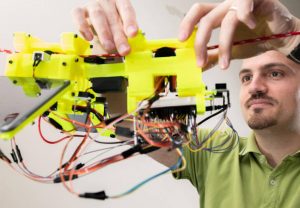
Georgia Tech is aiming at environmental monitoring, precision agriculture, and infrastructure maintenance with an aerial robot that trades speed for energy-efficiency.
Called SlothBot, it is intended linger for months, hanging at height from a network of wires, measuring chemical concentrations or other parameters that can only be recorded by a long-term presence.
Being wire-suspended allows the robot to move to locations where measurement is required and, by moving slowly, its energy demands are small, reducing the size of associated batteries and solar cells.
“In robotics, it seems we are always pushing for faster, more agile and more extreme robots,” said engineer Professor Magnus Egerstedt. “But there are many applications where there is no need to be fast. You just have to be out there persistently over long periods of time, observing what’s going on. Most of the time SlothBot will be just hanging out there, and every now and then it will move into a sunny spot to recharge the battery.”
Inspiration came form the sloths of South and Central America, that hang from branches and, according to the university, survive on calories equivalent to a small potato each day.
“The life of a sloth is pretty slow-moving,” said project consultant Jonathan Pauli, and ecologist from the University of Wisconsin-Madison. “The nice thing about a very slow life is that you don’t really need a lot of energy input. You can have a long duration and persistence in a limited area with very little energy inputs.”
Life on a wire
If such a robot is to do more than run along a single wire, it will need to swap around between wires that are joined in a Y-shape, or that are joined where they cross.
“The challenge is smoothly holding onto one wire while grabbing another,” said researcher Gennaro Notomista, who designed and built a proof-of-concept wire-navigating robot with colleague Yousef Emam. “It’s a tricky manoeuvre and you have to do it right to provide a fail-safe transition. Making sure the switches work well over long periods of time is really the biggest challenge.”
Mission impossible?
Hanging from a wire, yet being able to turn left or right at a Y junction, brings with it a problem – the wire-not-taken has to be able to pass through the hanging mechanism to both the right and left (respectively) – meaning that there can be no permanent link between the robot part that sits on the wire and rest of the robot hanging underneath.
The cunning mechanism – looking at the front of the robot – the wire runs from you, through the slot and out the back
Georgia Tech’s solution to this problem is going to take well over a thousand words to explain, so instead take a look at the photo on the left – whose slot allows it to run on both wire or tape.
The cog-with-a-gap hangs the bulk of the robot from the part that slides on the wire and, using the lower servo-driven gear, can be rotated clockwise or anti-clockwise to allow the wire-not-taken to pass to the right or left (respectively, from viewer’s perspective).
Forward motion comes from a motor-driven wheel pushing up under the wire, and to give it something to push against there is a long flat slider with a gapped-cog mechanisms at each end.
A gapped-cog mechanism at each end and a central drive wheel is almost all SlothBot needs to get around its wiry world – except that it cannot handle arbitrary situations – going straight-on at a right-angled crossing will be tricky, for example.
GaTech-slothbot3Pushmi-pullyu
To improve its maneuverability, SlothBot is in two halves, connected by a servo-driven hinge (visible in photo right) that bends it in the middle like a short snake. Each half has a gapped-cog mechanism at each end and its own drive wheel (all out-of-sight in this photo, one wheel drive motor is visible).
So far the robot has only operated indoors, but a printed shell is planned that will protect the necessary motors, gears, actuators, camera and computer from the weather, as a prelude to tests in the tree canopy at the Atlanta Botanical Garden – possibly in the autumn.
Further testing of a SlothBot is then on the cards for a cacao plantation in Costa Rica that is home to real sloths. “The cables used to move cacao have become a sloth superhighway because the animals find them useful to move around,” said team leader Egerstedt “If all goes well, we will deploy SlothBots along the cables to monitor the sloths.”
For further explanation of the SothBoth mechanism, there is a video, and a paper called “The SlothBot: A novel design for a wire-traversing robot‘ published in IEEE Robotics and Automation Letters. Sadly, only the abstract is available free, and it is a little light on detail. It was also described at the International Conference on Robotics and Automation (ICRA) in Montreal in May.